Cart
0
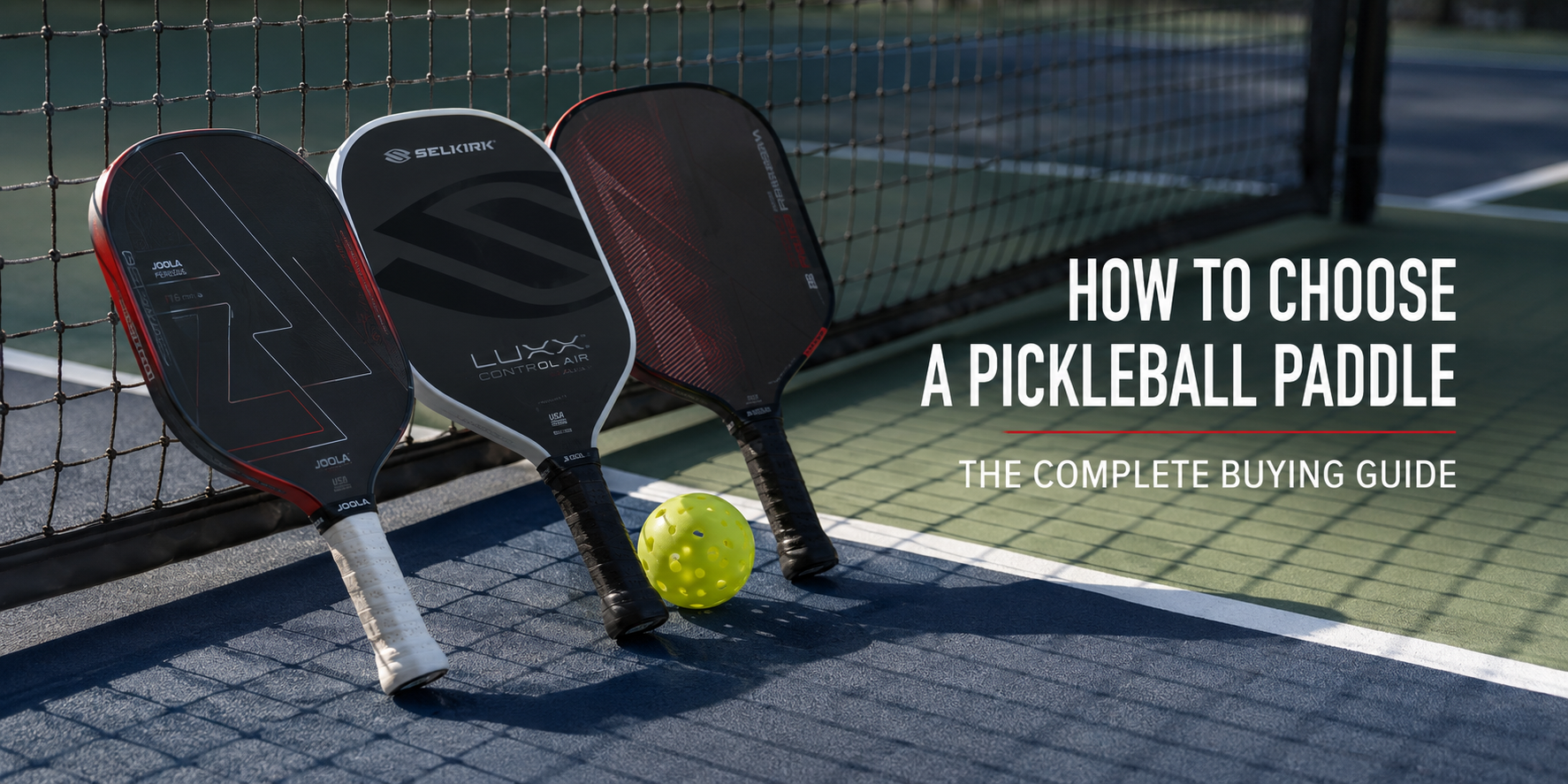
Choosing the right pickleball paddle can improve comfort, consistency and confidence on the court. The best paddle is not automatically the most expensive one. It is the paddle that suits your playing style, preferred feel, hand size and current skill level.
Quick answer
Most new and recreational players are well served by a midweight, standard or widebody paddle with a comfortable grip and a forgiving sweet spot. Players seeking more reach and power may prefer an elongated shape, while control-focused players often favour a thicker polymer core and a carbon fibre face.
| Playing style | Good starting point | What it supports |
|---|---|---|
| Control | Standard or widebody shape, thicker core, textured carbon fibre face | Placement, resets, blocks and touch near the kitchen |
| All-court | Midweight paddle, standard or hybrid shape, balanced construction | A practical blend of manoeuvrability, stability, power and control |
| Power | Elongated or power-oriented shape, firmer face, thinner or more responsive core | Drives, serves, overheads and added reach |
1. Choose the right paddle weight
Static weight affects how quickly the paddle moves, how stable it feels on contact and how tiring it may feel over a long session. Weight labels vary by brand, but paddles are commonly described in three broad groups:
- Lightweight: Easier to accelerate and manoeuvre quickly. Useful for fast hands, but it may feel less stable against hard shots.
- Midweight: A balanced starting point for many players because it combines reasonable speed, stability and power.
- Heavier paddles: Can provide more stability and momentum through the ball, but may feel slower or more tiring.
Fit tip: Do not choose by scale weight alone. Two paddles with the same listed weight can swing very differently depending on how the weight is distributed.
2. Pick a paddle shape that matches your game
Standard or widebody
Usually offers a larger, more forgiving hitting area. It is a strong choice for beginners, doubles players and anyone prioritizing consistency.
Hybrid
Blends some of the reach of an elongated paddle with a more generous sweet spot. It suits versatile all-court play.
Elongated
Provides extra reach and often more leverage, but typically has a narrower sweet spot and can feel slower in quick exchanges.
3. Understand core thickness and feel
Most modern paddles use a polymer honeycomb core. Core thickness and construction influence softness, dwell time, power and feedback.
- Thicker cores, often around 16 mm: Generally feel softer and more stable, making them popular with players who value control, resets and comfort.
- Medium-thickness cores: Aim to balance touch, responsiveness and manoeuvrability.
- Thinner cores, often around 13 to 14 mm: Tend to feel firmer and quicker off the face, which can suit players looking for added pop and faster hand speed.
Thickness is only one part of the design. Foam, perimeter weighting, face construction and the shape of the paddle can change how a core performs.
4. Compare paddle face materials
| Face material | Typical feel | Often suits |
|---|---|---|
| Fiberglass or composite | Responsive, lively and often power-friendly | New players and players who prefer easier depth and pop |
| Carbon fibre | Controlled, consistent and commonly paired with textured surfaces | Players who value spin, touch and predictable response |
| Graphite | Light, crisp and responsive | Players seeking a quick, precise feel |
5. Check grip size and handle length
A comfortable grip helps you maintain control without squeezing excessively. A grip that is too large can restrict wrist movement, while one that is too small may require extra tension to keep the paddle secure.
- Choose a circumference that feels secure with relaxed fingers.
- A smaller grip can be built up with an overgrip.
- Players using a two-handed backhand should check that the handle provides enough usable length.
- Replace worn overgrips regularly so the handle does not become slippery.
6. Look beyond static weight
Two measurements can help explain why paddles with similar listed weights feel different:
- Swing weight: Describes how heavy the paddle feels while swinging. A lower swing weight generally feels quicker, while a higher swing weight can add momentum and stability.
- Twist weight: Relates to resistance against twisting on off-centre contact. Higher stability can make a paddle feel more forgiving.
These measurements are not always listed by every manufacturer, so an in-hand test remains valuable.
7. Match the paddle to your skill level
Beginner
Prioritize comfort, a generous sweet spot and predictable response. A midweight standard or widebody paddle is usually easier to learn with than a narrow, highly specialized design.
Intermediate
Choose according to the part of your game you are developing. A hybrid or elongated paddle may add reach, while a thicker control paddle may improve resets and touch.
Advanced
Focus on specific performance traits such as swing weight, twist resistance, handle length, surface feel and the power-to-control balance that complements your technique.
8. Set a practical budget
Entry-level paddles can be perfectly suitable for casual play and learning the sport. Mid-range paddles often provide improved materials, comfort and consistency. Premium paddles may add specialized constructions, refined weight distribution and performance-focused surfaces.
Spend more only when the additional features support a need you can identify. Fit, comfort and playing style matter more than price alone.
Before you buy: quick checklist
- Does the paddle feel comfortable after repeated swings?
- Is the shape appropriate for your preferred balance of reach and forgiveness?
- Does the grip fit without excessive squeezing?
- Does the core and face combination match your power or control preference?
- For sanctioned competition, does the paddle meet the approval requirements of the event?
Pickleball paddle FAQs
What is a good pickleball paddle for a beginner?
A forgiving standard or widebody paddle with a comfortable grip and moderate overall weight is a sensible starting point. It should feel stable without being difficult to manoeuvre.
Is carbon fibre better than fiberglass?
Neither material is automatically better. Carbon fibre is often selected for control, consistency and spin potential, while fiberglass or composite faces can feel livelier and more power-oriented.
Is an elongated paddle better?
An elongated paddle can provide extra reach and leverage, but its narrower shape may be less forgiving. Players who prioritize a larger sweet spot or quick hands may prefer a standard, widebody or hybrid shape.
How often should I replace my pickleball paddle?
There is no fixed replacement schedule. Consider replacing it when the face, edge guard or handle is damaged, or when the paddle no longer produces the consistent response you expect.
Complete your pickleball setup
The right ball, grip and carrying solution can also improve your experience. Browse our pickleball accessories and pickleball balls to complete your setup.
Shop pickleball paddles in Canada
Explore beginner-friendly, all-court, control and power paddles from leading pickleball brands at Sports Circuit.
Shop Pickleball Paddles